Have We Met? is a special storytelling series celebrating the 35th Anniversary of the Seattle Department of Neighborhoods. Throughout the next 365 days, we’re introducing the people who help shape Seattle’s neighborhoods every day; gardeners, volunteers, organizers, advocates, artists, leaders, City staff, and neighbors who care deeply about their communities. These short conversations offer a glimpse into the lives, passions, and places that embody our work and make Seattle feel like home.
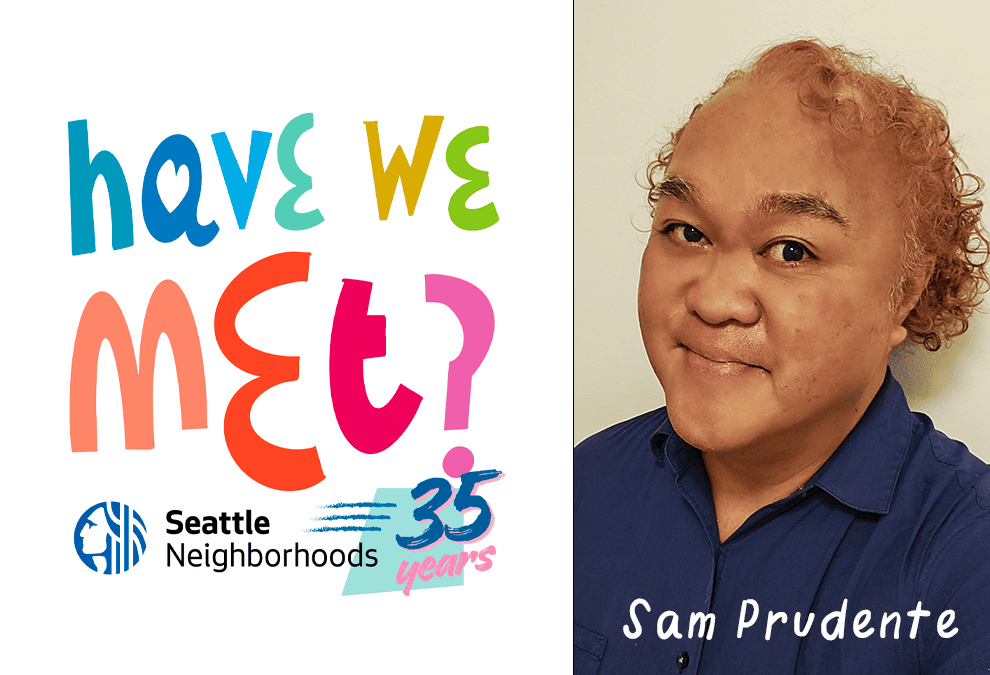
We recently connected with Sam Prudente, a 2024 People’s Academy for Community Engagement (PACE) participant, to learn about their experience in the program, gaining insight into local government, and shaping community leadership skills. Sam was part of cohort hosted in partnership with Asian Counseling and Referral Services. Meet Sam!
What motivated you to join PACE?
As an older immigrant prior to acquiring my citizenship, I kept my head down and found ways to survive and thrive. Despite my intent to engage more, there was no clear path to direct advocacy while my work and class schedules kept changing. After COVID shutdowns, I settled into a new job at Asian Counseling and Referral Services (ACRS) and discovered that our organization was partnering with the Department of Neighborhoods to host a PACE cohort and it was just a natural fit.
Before PACE, what was your experience engaging with local government? What skills did you gain from the experience?
I attended several activities and work orientation events at City Hall while studying at the University of Washington, so I felt comfortable with navigating the space. I understood the basics like where things were and basically what happens in those spaces, where the public could go, and finding ways to express support for legislation and budgets, but I never actually participated in doing those things. I didn’t have the time or energy to invest in advocating for or against a particular proposal or policy being considered, and I had never taken the time to write or make public comments on any issues.
PACE showed me the structures and processes of decision making. One way I have been able to raise my voice and represent the Asian community is by volunteering as the emcee/host of the city council and mayoral candidate forums at the Wing Luke Museum in past election cycles. Learning about issues allowed me to feel confident in asking critical questions to all the candidates. I felt more connected to the day-to-day procedures at city hall. I’ve also been able to write with more confidence to address not just city issues, but also state and federal policies.
What’s something you learned through PACE that changed how you see the City?
Being in City Hall and having the opportunity to speak with our representatives made a lasting impression on me. Simple things, like hearing about their own experiences, how they appreciate each other and the resourcefulness of their staff, drove home for me how committed public servants are to their constituents.
I’ve always viewed the PNW tendency toward community activism for making changes in a positive way. Often, what gets highlighted in media are remarkable protest actions or troubling incidents, but underneath it all is a steadier stream of incremental change and processes that are set up to scaffold those seismic shifts. How people navigate the long game; how they hold space for it and provide the foundation for it to happen; how they tend to their network and strengthen their commitment (whichever side of an issue they happen to advocate for) were questions that came up for me. I asked myself, “How do we get together to compound our efforts, building strength on strength?” There wasn’t a way, so we built one.
What does community power mean to you now?
I don’t think of power as a compounded entity, at least not in the fabled way a single stick could be easily broken compared to a bundle of sticks. The nature of community power is necessarily transformative. As individuals contribute to a system establishing its own power base, the very act of holding that space and going through the process changes how individuals carry themselves in relation to the whole. Therefore, community power provides a self-actualization pathway. For me, as a facilitator holding space for PACE alumni, I am curious about how this community emerges.
How does PACE reflect your community’s values or experiences?
During my cohort, it felt like we had a pretty cohesive group of folks whose advocacies aligned, but as we look toward including more alumni and their colleagues, there are more opportunities for us to build working groups on specific focus areas like housing justice, LGBTQIA rights, immigration issues, and safety.
What does leadership look like to you after participating in PACE?
My leadership template has shifted from being the forerunner to the empowered generator, the facilitator of integral growth. I feel more equipped to help build a city that includes a healthy, active, and engaged citizenry whose analysis of benefits defaults toward the good of all and not just personal gain.
Programs like PACE are important right now because, when the world gets to be too much and sarcasm and hopelessness threaten to take over, we must remind folks that we’ve got this. We can only influence what we can control, so it’s up to us to come together to focus on our energy and use our voices in ways we can actually make meaningful change.
The People’s Academy for Community Engagement (PACE) partners with linguistically and culturally specific organizations to co-create civic education programming. Learn more about PACE: www.seattle.gov/neighborhoods/public-participation/peoples-academy-for-community-engagement