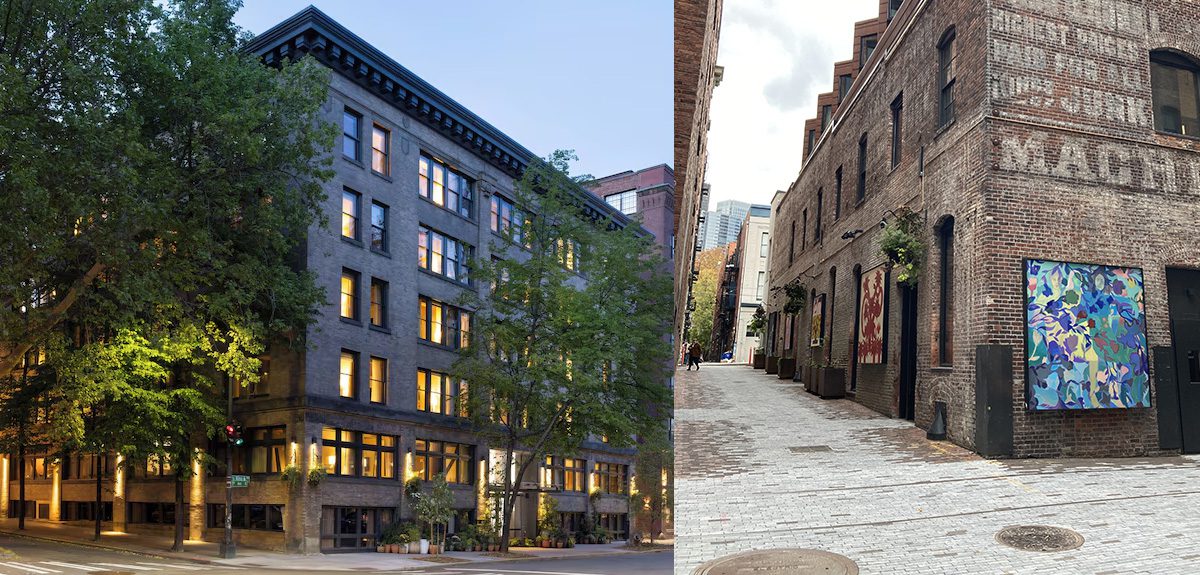
 Populus Hotel exterior and surrounding alley
 In the heart of Seattle’s Pioneer Square Preservation District, where the scent of salt air mingles with the ghost of sawdust and steam, stands the Populus Hotel. Named for a genus of species of deciduous flowering plants in the willow family which includes the famous Quaking Aspen, this renovated historic landmark stands as a living bridge between the city’s rugged past and its green future. Just as storytelling keeps memories alive, historic structures and features need us to breathe life into and maintain them and maintain. Seattle Department of Neighborhood’s Historic Preservation program keeps history alive by caring for Seattle’s architectural legacy and by discovering and sharing the stories of these places and features.
The Westland Building was built as a pipe-fitting warehouse in 1907 along the rail lines in Pioneer Square to provide easy access to load and unload cargo when downtown Seattle served as a hub for trade and travel within the region. Reopened in May 2025 as the Populus Hotel, many original features remain.
Working with the Pioneer Square Preservation Board, the design team, led by Miller Hull Partnership, thoughtfully restored the building, repurposing nearly 80% of the original structure. From Douglas fir beams to exposed car decking preservation isn’t about keeping things the same; it’s about evolving with integrity. If you take a lap around the building, you’ll find remnants of honed train rails poking out of newly poured concrete while indoor beams from the former loading bays create a spatial rhythm in the restaurant, reflecting the industrial layout that once welcomed cargo from incoming trains. Ultimately, the building’s presence is a testament to “adaptive reuse”—the idea that the greenest building is the one already standing.
Even in places where the building was inconvenient, [the design team] embraced it. That made it really special, quirky. The Populus is an interesting and inviting place to be. History is not lost, it’s still here.
-Genna Nashem, Coordinator for Pioneer Square Preservation District, Department of Neighborhoods
In the surrounding alleys, the team worked with Forest for the Trees who commissioned artists to create outdoor art mounted to the walls that create a open air public gallery throughout the Preservation District. The new art mixed with the historic preservation in Pioneer Square upholds “tradition rather than ends it,” says Dominic Nieri, Director of Creative Strategies at Urban Villages. The neighboring buildings and Populus combine to create a whole-block development that includes work, live, dining, and retail. It brings foot traffic back to the historic corridors, supporting the galleries and bookstores that give the area its soul, ensuring the city’s oldest neighborhood still has new stories to tell.
The Seattle Channel recently interviewed community leaders from Pioneer Square and took the project team to get a closer look at this piece of history. Check out their video about the Populus to learn more.
Seattle Department of Neighborhoods’ Historic Preservation Program is responsible for the designation and protection of more than 400 historic structures, sites, objects, and vessels, as well as eight historic districts located throughout the city. The Historic Preservation Program is housed within the Department of Neighborhoods. Since its founding in 1991, the Seattle Department of Neighborhoods has supported community-led projects and programs that strengthen connections, build trust, and help neighbors shape the future of Seattle together such as Neighborhood Matching Fund, P-Patch Gardening Program, Food Equity Fund, People’s Academy for Community Engagement (PACE), and more.